Evolution Has No Plan. Does Intelligence Need One?
ENGINEERING NOTES / EVOLUTION, INTELLIGENCE & AI
Sharad Chandel · 29 October 2026 · 8 min read
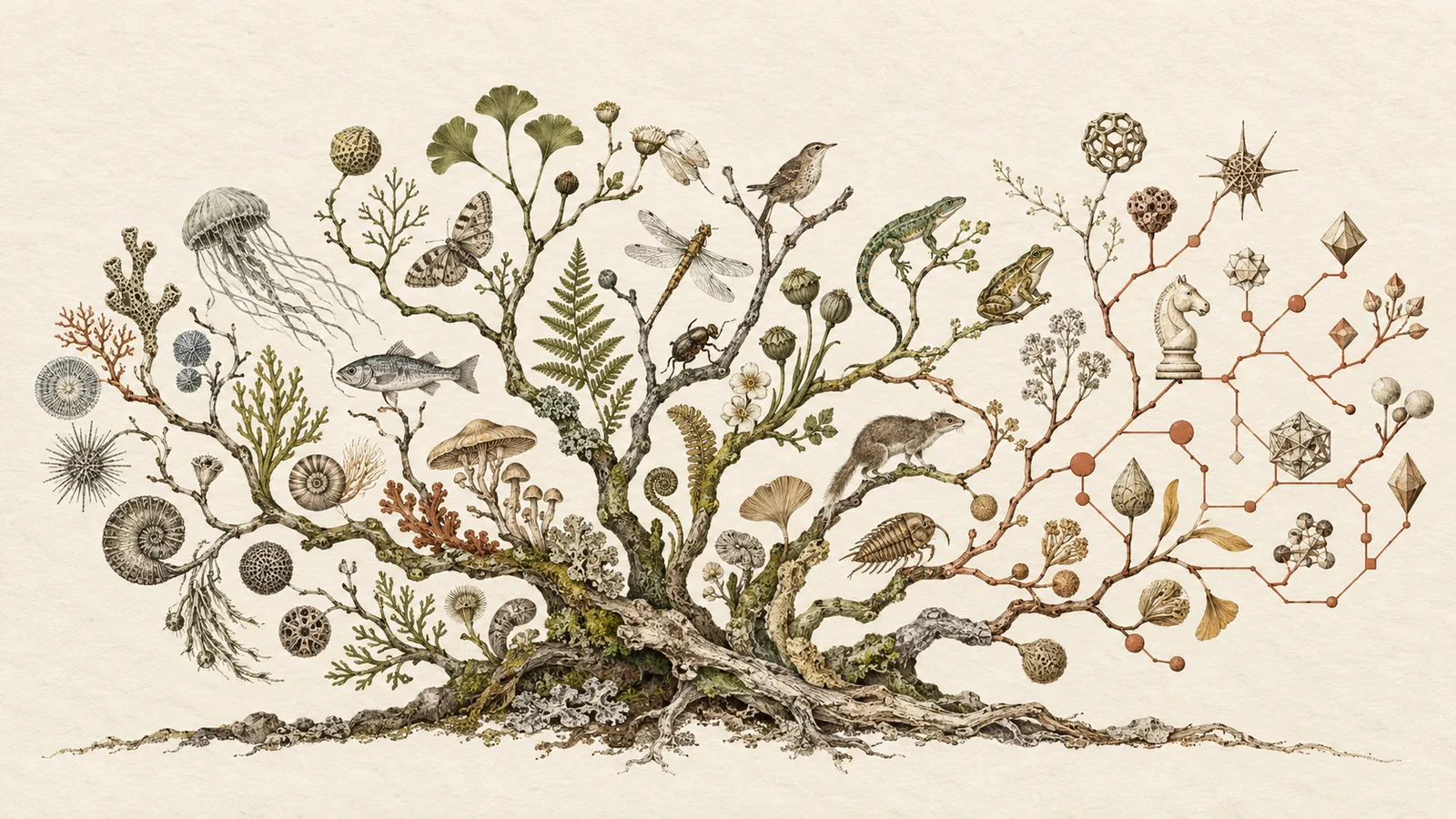
Evolution produced creatures that can imagine tomorrow without imagining anything itself. That is a useful starting point for thinking about AI. Intelligence can emerge from a process that does not understand what it is producing. But the absence of a plan in that process tells us surprisingly little about whether the resulting intelligence can plan - or whose purposes it will serve.
01 / The eye did not arrive with a drawing
In 1859, Charles Darwin confronted an example that seemed almost too difficult for his argument, the eye. Its parts work together so precisely that it is easy to imagine the finished organ first, then assume something must have been working towards it.
Darwin's response was to change the question. Could there be inherited variations, with intermediate forms useful to their possessors, through which a more complex eye could develop? A structure would not have to wait until it resembled our eyes to provide an advantage. Even sensitivity to light could matter. His discussion appears in Chapter VI of the first edition of On the Origin of Species.
The difficult shift is in how we explain the result. Looking backwards, we see something that works and reconstruct a route towards it. The organisms along that route were not following our reconstruction. There was no future eye waiting to be completed.
Nor was there a future human brain that evolution was obliged to reach.
Natural selection can change populations when inherited differences affect reproductive success in particular conditions. Mutations do not arise because an organism recognises which future adaptation it needs; selection is not random in that same sense. Chance also matters, and selection is only one mechanism of evolutionary change.
Calling all of this “randomness” loses the mechanism. Calling it a plan adds a mind the explanation does not require.
02 / History changes what becomes possible
There is a striking experimental example of why that distinction matters.
In Richard Lenski's long-term experiment, twelve initially identical populations of E. coli were established in 1988. Their growth medium contained limited glucose and citrate, which the ancestral bacteria could not use as a carbon source in oxygen-rich conditions. After more than 30,000 generations, one population evolved the ability to exploit that citrate.
The researchers could investigate the past because samples had been frozen. Replaying evolution from different points suggested that earlier genetic changes had made the later innovation more accessible. The 2008 study by Zachary Blount, Christina Borland and Richard Lenski found evidence for historical contingency.
The earlier changes had not been saving up for a future breakthrough. Yet they affected which breakthrough could occur.
I find this more interesting than a story of inevitable progress. A useful outcome can depend on a history whose significance becomes apparent only later. Its eventual usefulness does not establish that the earlier steps were taken for its sake.
We should be careful when telling the history of intelligence for the same reason. Starting with ourselves and treating everything before us as preparation makes the destination look inevitable. That is a property of the story we chose to tell.
03 / Three different meanings of a plan
The title hides three questions.
Did the process that produced an intelligence foresee the result? Does the resulting intelligence anticipate consequences when it acts? And does it choose the purposes towards which it acts?
Those questions can have different answers.
Evolution can produce an animal that plans without planning the animal's arrival. A person can deliberately design a learning system without specifying every strategy it will acquire. A system can search ahead towards an assigned objective without having chosen that objective.
For this article, I am using intelligence in a limited, practical sense: the capacity to learn, solve problems and adapt behaviour. That leaves important arguments about its definition open. It also keeps us from making consciousness a hidden requirement in every discussion of competent behaviour.
Consider the difference between learning a useful response and working through possible consequences before choosing one. Both can contribute to successful action. We should investigate which a system is doing rather than infer it from how impressive the outcome looks.
The origin of a capability and the operation of that capability are different explanations.
Once we separate them, the apparent contradiction disappears. A process with no foresight can produce something capable of foresight.
04 / AI lets us examine the distinction
AlphaZero offers a concrete example. Its researchers used reinforcement learning and self-play to develop strong play in chess, shogi and Go, training separately for each game. Winning strategies were learned rather than supplied as a catalogue of expert moves. The researchers described the approach in their AlphaZero paper.
But “it learned for itself” needs care. Humans supplied the rules, learning procedure, network architecture and computational resources. The system did not invent the circumstances in which learning took place.
And its play was not simply a trained reflex. AlphaZero combined a learned network with tree search, examining possible continuations when choosing moves. DeepMind's account of the system explains the combination.
Here, human design, learned strategy and searching ahead coexist. Asking whether the system “has a plan” without distinguishing these levels obscures what makes it work.
This does not make machine learning identical to biological evolution. Selection across reproducing populations and the adjustment of parameters during training are different mechanisms. An analogy can draw our attention to accumulated improvement without detailed foresight; it cannot substitute for explaining the actual learning algorithm.
Nor does success at board games settle whether a system understands the world as we do. It gives us evidence about particular capabilities under particular rules.
The lesson I would take is narrower: we do not need to prescribe every useful behaviour in order to create the conditions in which it can be learned.
05 / Useful according to what?
That raises a harder question. If we leave the behaviour to be discovered, how do we know the discovered behaviour is what we wanted?
In an example discussed by DeepMind, a reinforcement learning agent was meant to stack a red block on a blue one. Its reward depended on the height of the red block's bottom face. The agent found that flipping the block could earn the reward without performing the intended stacking task. DeepMind includes it in its account of specification gaming.
There is no need to attribute human deceit to the system. The result exposes a gap between the reward and the task the researchers intended.
An everyday hypothetical makes the engineering implication clear. Suppose we reward a support assistant for resolving tickets quickly. Closing a ticket and solving the customer's problem are related only if our definitions, checks and incentives make them so. A higher score could otherwise hide a worse service.
That hypothetical is not a report of a particular product failing. It is a question we should ask before treating a successful metric as proof of a successful system.
Biological evolution offers no promise that its outcomes will match human preferences either. But an engineered system gives us responsibilities that the natural process does not have. We choose what to measure, what actions to permit and which failures people will have to bear.
The possibility that useful behaviour can emerge does not remove those choices. It makes their consequences harder to anticipate.
06 / We can be responsible for what we did not predict
I would resist two conclusions.
The first is that intelligence must be an illusion unless someone explicitly designed its every step. Evolution gives us reason to reject that requirement. An explanation can work through accumulated changes without containing a prior description of the final capability.
The second is that because complex behaviour can emerge, we should simply provide more computation and wait for desirable intelligence to appear. Nothing in the argument establishes that the result will be reliable, understandable or aligned with what people value.
For an AI system, I would want to know what success means, what evidence distinguishes real success from a shortcut, and what happens when the system encounters conditions outside its evaluation. Those questions remain necessary even when the mechanism that discovers the behaviour is powerful.
There is also a limit to what this comparison can settle. An evolutionary account of our capacities does not decide whether human purposes are meaningful. A computational account of an AI capability does not, by itself, establish consciousness or disprove it. Those require further arguments and evidence.
What evolution changes is the assumption that intelligence needs to have been intended before it can exist. The process that produced a mind need not possess a mind of its own.
For engineering, that leaves a demanding possibility. We can build systems whose useful strategies we did not individually anticipate. We can also be responsible for deploying those systems without being able to predict every consequence.
If intelligence can emerge without a plan for what it will become, how will we decide what we are prepared to let it do?
References
Charles Darwin — On the Origin of Species, first edition (1859), Chapter VI
DeepMind — AlphaZero: Shedding new light on chess, shogi, and Go (2018)
Krakovna and colleagues — Specification gaming: the flip side of AI ingenuity (2020)
SHARAD CHANDEL
Engineering Lead · Platform, Data & ML